Valentine Tissot
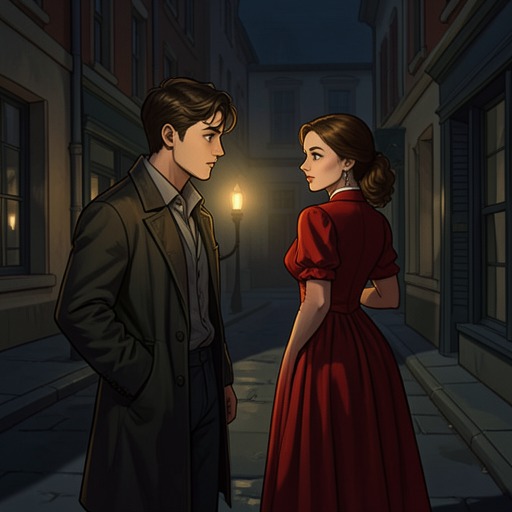
The King in YellowValentine Tissot is introduced as a woman whose presence immediately unsettles Foxhall Clifford and whose private circumstances are concealed from the people around her. She asks Hastings to protect her identity and later admits that he is the source of her great distress of mind. Her story reaches its decisive turn on a train leaving the city, where resistance collapses into an anguished confession of love, betrayal, and helplessness.
Identity and Introduction
Valentine first appears at a fountain after Foxhall Clifford has been discussing Hastings and preparing to catch the Versailles train. Her approach changes Clifford's manner at once: he removes his hat with a confused smile, and when she asks why he is not at Versailles, he answers hesitantly that he is going. Their exchange exposes a connection that Clifford cannot comfortably explain, while Valentine acknowledges Hastings only almost imperceptibly. Clifford then introduces Hastings as his friend, making Hastings a witness to an encounter whose significance is not yet clear.
The scene presents Valentine through restraint rather than disclosure. Her reserve is not simple shyness; it is a form of self-protection. She enters a social setting in which men already possess partial knowledge about her, yet she controls how much of herself can be spoken aloud. The contrast between Clifford's redness and stammering and her nearly invisible acknowledgment of Hastings establishes her as the more composed figure, even though later scenes reveal that her composure conceals intense emotional pressure.
Secrecy and Social Movement
Valentine soon gives Hastings a name and a request. She identifies herself as Valentine Tissot and asks whether, despite their very short acquaintance, he might perform a service. When he readily agrees, she specifies that he must not speak to Foxhall Clifford about her and must tell no one about her. The request transforms their meeting into a confidential alliance before affection or trust has had time to develop openly.
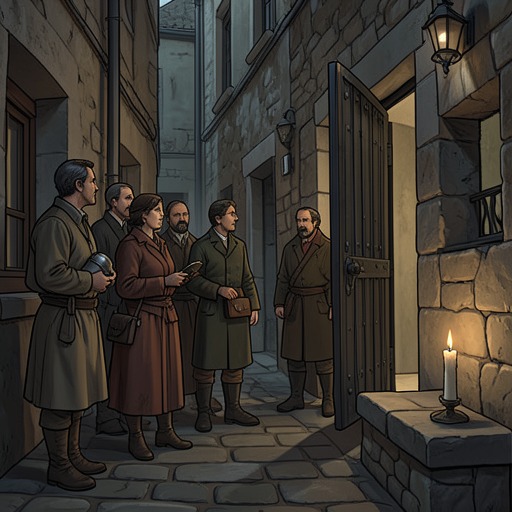
Her secrecy governs her movements through Paris. After telling Hastings that she must return alone, she passes through the grove, turns into the rue de Medici, crosses to the Boulevard, and continues toward the rue des Écoles. At the Boulevard she buys a bunch of violets, a small public gesture that contrasts with the concealment surrounding her larger life. Before Boulant's, a cab arrives with a pretty girl assisted by Richard Osborne Elliott. The girl calls to Valentine and invites her to join them, but Valentine refuses because she has a rendezvous at Mignon's. Her route therefore appears to be composed of overlapping social worlds: she is recognized, invited, and watched, yet she remains committed to an appointment whose importance she does not explain.
These details make her secrecy active rather than merely accidental. She does not simply hide; she chooses routes, appointments, companions, and silences. The violets and the rendezvous give her movements a surface of ordinary Parisian sociability, while the repeated requests for discretion reveal a more precarious reality beneath it.
Distress and Conflicting Loyalties
Valentine later confronts Clifford directly. She tells him that she is in his power, but also insists that she knows she is in the power of a friend. She has come to acknowledge that dependence and to beg a favor. When Clifford asks what troubles her, she names Hastings: her great distress of mind is specifically connected with him. Her unfinished request concerns what Clifford might say about her if he speaks before Hastings, but she cannot immediately complete the sentence.
This exchange clarifies the structure of the conflict. Hastings is not merely an attractive stranger encountered by chance; his presence threatens to expose a secret involving Valentine, Clifford, and another obligation. Valentine seeks Clifford's silence while simultaneously moving toward Hastings, so that every attempt to preserve one relationship places another under pressure. Her language of power, friendship, and favor also shows that she understands the ethical danger of the situation. She does not present herself as free to pursue desire without consequence; she knows that another person has trusted her and that her choices may constitute a betrayal.
The Train and the Collapse of Resistance
The train journey carries Valentine away from the city and gives the hidden conflict a temporary space in which it can be spoken. She leans far out of the window as the train passes a river, a tunnel, and green fields, crying for greater speed and urging escape from the city, the land, and the world. The movement outward is both literal and emotional: the train creates distance from the social network in which her identity and promises are constrained, but it also drives her toward a decision that cannot remain concealed.
When Hastings catches her by the waist to keep her from leaning too far, she turns and sees his arm around her. He kisses her, and she responds with a bitter, hopeless cry: "Not that—not that!" She explains that she has promised and that she is not worthy, but Hastings does not understand the full meaning of her words. His own love makes the warning seem meaningless to him, while for Valentine it remains the central fact of the scene. Her resistance is therefore not a rejection caused by lack of feeling; it is the expression of a prior commitment and of the guilt attached to breaking it.
Her resistance finally gives way. She tells Hastings that she cannot turn from him because she is too weak, that he has long been master of her heart and soul, and that she has broken her word to someone who trusted her. She also says that she has told him all and asks him either to take her or cast her away. The confession joins emotional surrender to moral self-condemnation. Happiness appears so overwhelming that death might seem easier than facing it, making the moment a triumph of love only in an unstable and deeply tragic form.
Relationships and Narrative Significance
Valentine's relationships are defined by unequal knowledge. Hastings receives her most intimate confession, yet he initially fails to comprehend the warning embedded in her words. Clifford knows enough to hold power over her and enough to be asked for silence, but the evidence does not make his exact connection to Valentine fully explicit. The unnamed person whose trust she has broken remains morally decisive even without being identified in these scenes: that absent figure turns Valentine's love into a violation of a promise rather than an uncomplicated romance.
Valentine nevertheless possesses a strong, if constrained, narrative voice. She names herself, sets the terms of Hastings's discretion, chooses when to return alone, refuses an invitation, identifies her distress, and finally articulates the depth of her attachment. Her speech is repeatedly interrupted by hesitation and unfinished phrases, but those breaks convey the pressure of competing loyalties rather than an absence of desire. The text grants her direct language at the very moment when she is most vulnerable, allowing her to define the conflict in terms of weakness, promise, power, and love.
The train scene also gives physical form to her divided condition. The carriage is a transitional space between the controlled social world of Paris and an imagined escape beyond the city. Its speed, rattling windows, forests, sunlight, and receding landscape intensify the sense that Valentine is being carried toward a choice faster than she can morally master it. Her departure from restraint brings emotional revelation, but not security: the available evidence ends with confession and surrender, not with a settled future or a secure resolution.